Every fast-growing company hits the same wall: strategy lives in a boardroom deck while day-to-day work has little to do with it. Goals get set, rarely reviewed, and the gap quietly widens.
OKRs were designed to fix that. Here’s what they are, how they work, and why so many organizations have made them central to operations.
What Is OKR? The Full Form and the Meaning
OKR full form: Objectives and Key Results. It’s a goal-setting framework that connects what an organization wants to achieve (the Objective) with measurable outcomes that signal progress (Key Results).
Objective: A short, inspirational statement of what you want to achieve. Example: “Become the most trusted brand in our category.”
Key Results: Two to five measurable outcomes that define success. Example: “Increase NPS from 42 to 65 by Q4.”
The Objective tells you where you’re going. Key Results tell you whether you’re getting there. Together they align the company level down to individual teams.
OKR vs KPI: What’s the Difference?
This is the question most organizations get stuck on. OKR vs KPI: they’re not the same thing, and they’re not competing with each other.
KPIs (Key Performance Indicators) track the ongoing health of your business via revenue, churn, and conversion rate. They tell you how the engine is running.
OKRs are goal-setting tools that tell you where the engine is going. A KPI might track monthly revenue; an OKR might focus on breaking into a new market segment.
Use KPIs as your operational baseline and OKRs as your growth levers.
OKR Implementation: How Companies Actually Use the Framework
Understanding what is OKR is the easy part. Effective OKR implementation is where most organizations either gain traction or lose it.
A well-structured OKR implementation plan typically covers: setting OKRs at company level first, cascading to teams, running check-ins through the quarter, and holding an honest end-of-cycle review to learn what to do differently.
OKRs were first formalized at Intel by Andy Grove in the 1970s and adopted by Google in 1999, where they became foundational to scaling the company while maintaining strategic clarity. Today, the OKR framework is used by organizations globally from early-stage startups to Fortune 500 companies.
OKR Benefits: Why Companies Choose This Framework
The OKR benefits that organizations consistently report go beyond just having clearer goals:
Alignment: Everyone from CEO to the newest team member can see how their work connects to the company’s most important priorities.
Focus: OKRs force a choice. Typically three to five Objectives per level, per quarter.
Accountability: Trackable Key Results create a culture where progress or lack of it is visible and owned.
Agility: Quarterly cycles mean companies can course-correct faster than annual planning allows.
Illustrative Program Snapshot
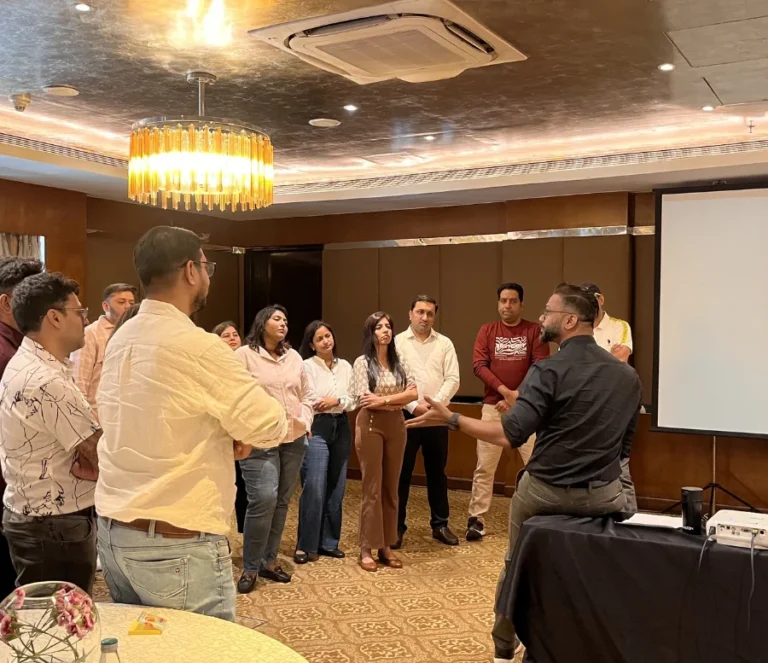
Program: OKR Foundation Workshop | Mid-size Consumer Goods Company | Senior Leadership Team of 18
A one-day foundation workshop followed by a four-week implementation sprint. The leadership team aligned company-level OKRs, cascaded them to four departments, and ran their first check-in. By the end, the organization had a working OKR cycle and an internal champion trained to run future quarters independently.
Their leadership training certification programs are built on internationally recognized frameworks. Every engagement begins with a structured discovery phase. Whether you need leadership training programs in Mumbai or a pan-India rollout, Atlas Learning builds around your goals.
Ready to Implement OKRs in Your Organization?
Knowing what OKR is and actually implementing OKRs in a company are two different challenges. The framework is deceptively simple and getting it right requires the right partner, sequencing, and a structured approach.
Atlas Learning has guided 200+ organizations through OKR implementation, from the first alignment workshop to a self-sustaining practice. Whether you’re exploring OKR best practices or ready to start, we’ll build around your goals.
Get in touch with us
Ready to talk? Reach out to the Atlas Learning team or explore our media gallery to see our programs in action
+91 98201 60888
Our Email
Kenneth@atlaslearning.in
Our Location
611, Fortune Emporio, Opposite Thakur Mall, Western Express Hwy, Mira Road East, Mira Bhayandar, Maharashtra 401107
Frequently Asked Questions
any question ? we got you
What is OKR in simple terms?
OKR stands for Objectives and Key Results. An Objective is what you want to achieve; Key Results are the measurable outcomes that tell you whether you’re getting there. Together, they align teams around what matters most.
How is OKR different from KPI?
KPIs measure how your business is running right now. OKRs define where you want to go. The two work best together: KPIs as your operational baseline, OKRs as your strategic growth levers.
How does Atlas Learning help with OKR implementation?
Atlas Learning follows a three-phase approach — Getting Started, The Learning Quarter, and Continuous Improvement — building both the first successful OKR cycle and the internal capability to run future cycles. Learn more about the OKR program here, or contact the team to discuss your rollout.