OKR Implementation for Companies: Complete Guide to Training, Consulting & Execution
Most companies don’t fail at OKRs because the framework is hard to understand. They fail because rollout is rushed, or nobody owns what happens after the first quarter. A good OKR implementation plan fixes both problems before they start.
What OKR Implementation Actually Involves
Implementing OKRs isn’t just writing goals and hoping people follow them. OKR stands for Objectives and Key Results, a simple structure where objectives describe what you want to achieve, and key results show how you’ll know you got there. But the method itself is the easy part. The real work is building the habits around it: clear ownership, weekly check-ins, and honest reviews at the end of each cycle.
This is different from an OKR vs KPI comparison people often get confused about. KPIs track ongoing performance. OKRs are time-bound, ambitious, and built to drive focused change over one cycle, usually a quarter.
How to Implement OKRs in a Company: The Practical Steps
A basic OKR implementation plan usually looks like this:
- Get clarity on why you’re introducing OKRs, and what problem they’re meant to solve.
- Pick a pilot group instead of rolling out company-wide on day one.
- Set 1-2 objectives per team, each with 2-3 measurable key results.
- Assign one named owner to every key result, not a team.
- Build a weekly check-in habit from week one.
- Run a short retrospective at the end of the cycle.
Teams that keep this lean tend to do far better. Companies running focused OKRs, one or two per team, are roughly twice as likely to actually achieve them, compared to teams juggling three or more goals at once.
If you’re planning your first rollout, get in touch with our team and we’ll help you build a plan that fits your company’s size and pace.
OKR Training for Companies vs OKR Consulting
This is a common point of confusion. OKR training for companies teaches your people the method itself, how to write good objectives, set measurable key results, and run the weekly rhythm. OKR implementation consultant support goes further: an outside expert works alongside your leadership team through the actual rollout, not just teaching the theory in a workshop.
Most companies need both. Training builds the skill. Consulting makes sure the skill gets applied correctly during the first, most fragile cycles.
See how a tailored corporate OKR implementation approach works on our OKR programs page.
Real Event Snapshot
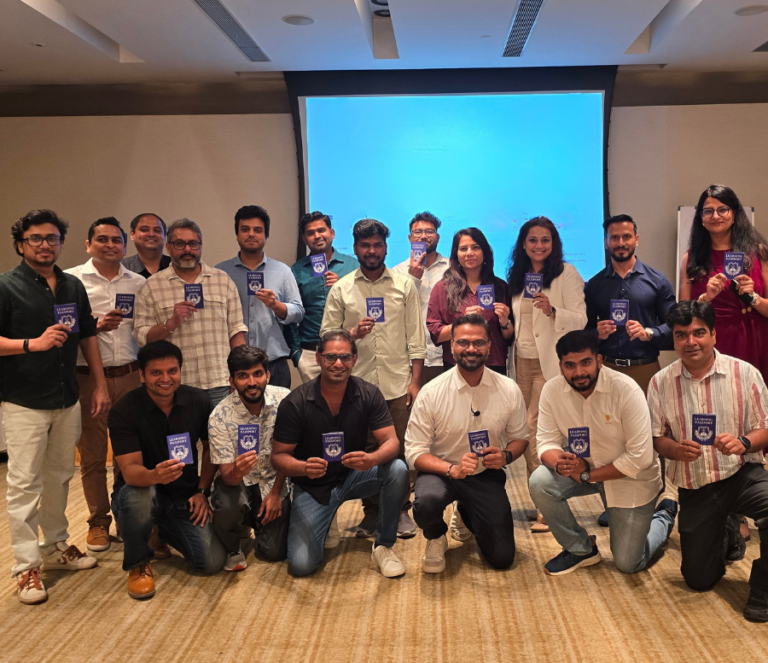
A two-day OKR implementation workshop for a 30-member leadership and mid-management group at a Bengaluru-based technology company. What made it work: the first day focused on writing objectives tied to real business priorities, and the second day was spent building the weekly check-in habit before the program ended, so the rhythm was already in place on day one of the actual cycle.
Why This Matters for Business Outcomes
OKR implementation in India is growing fast as companies look for a simpler way to connect strategy to daily execution. One industry benchmark study found that 98% of organisations reported measurable revenue growth after implementing OKRs properly, a strong sign this isn’t just a planning exercise, it’s a business decision.
Curious what a tailored OKR implementation process looks like for your team? Schedule a consultation or explore our recent work and insights.
Get in Touch
If your company is exploring OKR consulting and implementation this quarter, the best starting point is a short conversation about where your current goal-setting process is breaking down. Contact Atlas Learning and we’ll help you figure out whether training, consulting, or both make sense for where you are.
+91 98201 60888
Our Email
Kenneth@atlaslearning.in
Our Location
611, Fortune Emporio, Opposite Thakur Mall, Western Express Hwy, Mira Road East, Mira Bhayandar, Maharashtra 401107
Frequently Asked Questions
any question ? we got you
Why do companies need OKR implementation?
Without a clear rollout plan, OKRs tend to become another planning exercise nobody follows past week four. A proper implementation builds the habits, weekly check-ins, named ownership, honest retrospectives, that make the framework actually stick and drive real business results.
What is the difference between OKR training and OKR consulting?
Training teaches your team the method itself: how to write good objectives and key results. Consulting goes further, an expert works alongside your leadership through the actual rollout, helping avoid the common mistakes that derail a first cycle.
What is a Certified OKR Practitioner?
It’s someone formally trained to write, coach, and run OKRs correctly within an organisation, often the internal owner who keeps the process alive after an external consultant’s engagement ends. Atlas Learning’s founder, Kenneth Lewis, is recognised as Asia’s first OKR consultant, and our OKR Certification program is built on that same practitioner-level depth.